Coinbase to acquire Agara to enhance our customer experience with powerful machine learning technology and expertise
TLDR: Acquisition reinforces Coinbase’s commitment to delivering world class support for customers; brings deep expertise in machine learning and natural language processing to Coinbase; and reconfirms Coinbase’s strategy to expand our tech hub in India.
By Manish Gupta, EVP, Engineering
Today, Coinbase is announcing that we are acquiring Agara, an AI-powered support platform with operations in India and the US. The acquisition reinforces our commitment to delivering world-class support for customers, and brings Agara’s deep expertise in machine learning (ML) and natural language processing (NLP) to Coinbase’s engineering team. It also reconfirms our strategy to continue to build out our tech hub in India.
We plan to leverage Agara’s powerful Deep Learning and Conversational AI technology to automate and enhance our customer experience (CX) tools. Improving our CX remains a top priority for Coinbase — in the past few months we have increased our support staff headcount by 5x and announced that we’ll deliver 24/7 phone support and live messaging by end of year. Through this acquisition, we’ll be able to provide our customers with new personalized, intelligent, and real-time support options.
In addition to Agara’s technology, the Agara team brings deep expertise in ML and NLP to Coinbase and will augment our existing product, engineering, and data teams.
Earlier this year, we announced our strategy to build out a tech hub in India, and we look forward to welcoming the Agara team to our rapidly growing presence across the country. Together, we will continue to advance Coinbase’s mission of increasing economic freedom around the world.
If you’re interested in joining our growing team in India — or anywhere around the world — we’re hiring. Come build with us!
This acquisition is subject to customary closing conditions and is expected to close later this year.
Trey Edwards shares his personal path to crypto and Coinbase, and how he’s creating opportunities for others to follow in his steps
I was on my way to my last class of undergrad at NC State University when I stepped off of the campus bus and was suddenly hit straight on by a car driven by another student. Luckily, I walked away with no long-term injuries, but it forever changed my outlook on life.
Prior to the accident, I was driven, but lacked a sense of urgency. I knew that I wanted to make something of myself, but always felt as if I could wait to get started. After the accident, everything changed. I was determined to make something of myself, and to get started immediately.
After graduation, I worked in different industries, including wine sales and technical recruiting, but couldn’t seem to find the right fit. That quickly changed once I began working for a Financial Technology (FinTech) consulting firm.
Being new to FinTech, I immersed myself in books and local meetups to learn everything I could. One day in mid-2017, I read a chapter on blockchain, which detailed the technology’s lofty aspirations of becoming more impactful than the internet itself.
I didn’t know it at the time, but this chapter would change my life. I found myself hooked and was increasingly fixated on one question:
If I truly believe that blockchain and digital currencies will change the world, what do I do with that knowledge? Do I continue to buy bitcoin and hope to get rich, or do I dive in and help build the future?
I chose the latter and I sought to learn as much as I could, eventually enrolling in the first (free) course for University of Nicosia’s Master’s in Digital Currency program, taught by world-renowned expert, Andreas Antonopolous.
After that first course, I knew I had found my passion. Ironically, my main challenge with enrolling in a Master’s program dedicated to the future of money was that I needed to have money to get started — which, at the time, I didn’t. Traditional graduate school loans weren’t an option, given the university was located outside of the U.S. As a result, I had to turn to a high interest personal loan to finance my studies.
Though the cost was high, with each course, I knew that I was a part of a program that would shape the future. The program focused on a variety of topics, including unpacking the concept of money, the technical intricacies of blockchain technology and the principles of innovation.
After a year of balancing both work and school full-time, I graduated Summa Cum Laude and became one of the youngest people in the world to earn the degree.
After graduating, it was important to me to find a company that I believed would help change the world, so I applied for a Project Manager position on the Advocacy team at Coinbase. In the span of three weeks, I ran a half-marathon, got the job at Coinbase and got married. (Honestly one of my favorite months ever!)
I know that blockchain and digital currency can be challenging concepts to wrap your head around, and my job at Coinbase is to help ensure that using our products is as effortless an experience as possible. I do this by partnering with our Product, Engineering & Design teams to advocate for our customers and help them understand the feature requests, bugs and ideas that customers let us know about. I also work closely with our support team to ensure that when people run into issues, our team is fully prepared to take care of them.
As mentioned, it was really important to me to find a company that I believed had the potential to change the world. Blockchain and digital currency are already reinventing finance and, in the process, creating an incredible amount of wealth for participants. As we work to build an open financial system, we have the opportunity to remedy racial inequities by ensuring Black and other underrepresented groups are not only aware of the technology but have a seat at the table to build it.
To help with this, I proposed an idea to Coinbase last summer to create a full scholarship for Black and other underrepresented minority professionals to obtain their Master’s in blockchain and digital currency. I believe that by doing this, we will foster the next generation of leaders in the cryptocurrency industry.
This idea was met with overwhelming support internally and for much of the past year, we’ve worked to iron out the details. I’m thrilled to say that we’ve now formalized the program and will be providing this scholarship for up to five talented individuals in the 2021–2022 academic year.
The first recipient of this scholarship for the Spring 2021 intake of the MSc program is Abrahim Adewunmi, a talented entrepreneur based in Oakland, CA. We are excited to have Abrahim be our first Coinbase Scholar as he shares our passion for leveraging blockchain and digital currencies to enhance economic freedom.
If you are interested in applying for the scholarship program, you’ll find more details on the University of Nicosia’s website. In the meantime, if you’re interested in joining me in building this open financial system, feel free to reach out or apply online at coinbase.com/careers.
We’ve already discussed the general notions of digital signatures and threshold signatures in a prior post. At Coinbase, we’ve focused our attention specifically on two-party threshold signing; we’ll discuss this setting in this post.
DKLs: an introduction. While threshold-signing protocols for the Schnorr and BLS schemes are relatively straightforward, threshold ECDSA is much harder. A number of protocols exist for 2-of-2 ECDSA signing; some target it explicitly (i.e., they don’t support more general choices of t and n). In this purely expository blog post, we’ll study one in particular: the 2018 protocol of Doerner, Kondi, Lee and shelat. This protocol builds on prior work of Chou and Orlandi and Keller, Orsini and Scholl. This protocol — or “DKLs”, for short — allows two parties to securely generate an ECDSA signature in just a handful of milliseconds, by exchanging just 3 messages, and all the while transmitting about 120 total kilobytes of data. In the process, it uses a few interesting techniques in secure two-party computation, and represents a disciplined, striking contribution to this field.
Let’s now say a few technical things about how DKLs works. The basic idea has to do with multiplicative secret-sharing of prime-field elements. If our two parties — Alice and Bob, say — locally generate random scalars sk_A and sk_B in 𝔽_q, then, after performing a Diffie–Hellman-like exchange, the parties may mutually derive the jointly owned public key P = sk_A · sk_B · G, without learning anything about each other’s respective key-shares (or the joint secret key). The joint secret key is the product sk := sk_A · sk_B (mod q). DKLs is unusual in its use of multiplicative sharing; the protocol fails to generalize to the (t, n) setting for essentially this reason.
The parties begin the process of ECDSA-signing a particular message m in an analogous way. They generate individual nonce-shares k_A and k_B randomly, and construct R := k_A · k_B · G as they did P; using R’s coordinates (x, y), they both acquire the first signature component r := x (mod p). It remains only for the parties to jointly construct s := H(m) · k⁻¹ + r · sk · k⁻¹ (mod q), as prescribed by the definition of ECDSA. The trouble is that the parties only possess multiplicative sharings of the quantities k and sk, and not the required values themselves.
DKLs observes that the expression defining s can just as well be written as:
The first key idea is that it would be enough for the parties to obtain random additive sharings of the two product expressions 1/k_A · 1/k_B and sk_A / k_A · sk_B / k_B above. Indeed, if the parties were to obtain such sharings, then they could both proceed by multiplying these local shares by H(m) and r, respectively, and adding the results (recall that both parties know H(m) and r). Upon doing so, the parties would acquire additive sharings of s itself, which they could finally safely exchange (i.e., without leaking any further information about s’s individual summands). Note finally that Alice can locally compute the left-hand multiplicands 1/k_A and sk_A/k_A; Bob can likewise locally compute the right-hand multiplicands 1/k_B and sk_B/k_B.
It’s thus enough to handle the problem of “secure multiplication”, also sometimes termed “multiplicative-to-additive conversion”. In this problem, two parties submit respective input scalars i_A and i_A, and wind up with random additive shares t_a and t_b of the product i_A · i_B (mod q). In other words, the identity t_A + t_B = i_A · i_B (mod q) should hold, and moreover the outputs t_A and t_B should be random subject to this condition; finally, the parties must learn nothing about each other’s inputs i_A and i_B in the process of executing the protocol (even if they engage in malicious behavior).
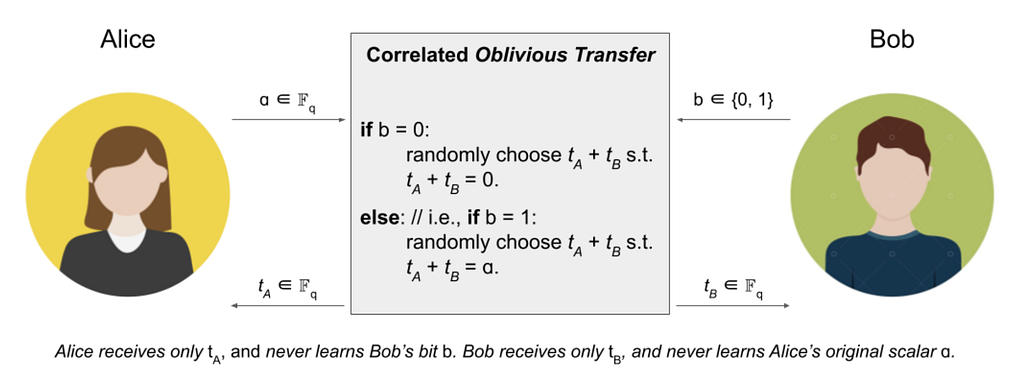
DKLs describes a fascinating secure multiplication subprotocol, using a further primitive called correlated oblivious transfer (cOT for short). In a cOT protocol, the parties Alice and Bob have asymmetric roles. Alice inputs a single scalar, say ɑ, in 𝔽_q; Bob inputs just a single bit b. The parties each receive a scalar as output; let’s again call these t_A and t_B for now. By definition of cOT, the outputs t_A and t_B should be random subject to the condition that t_A + t_B = ɑ if Bob’s input bit b is 1 and random subject to t_A + t_B = 0 if Bob’s input bit is 0. Either way, the sender should learn nothing about the receiver’s bit b, and the receiver should learn nothing about the sender’s scalar ɑ. The definition of correlated oblivious transfer is illustrated in the figure below.
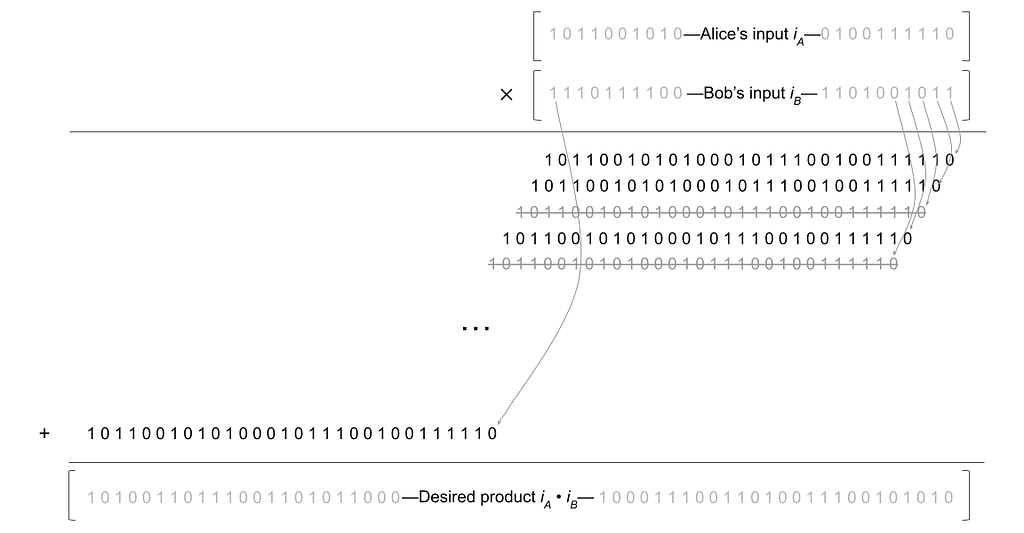
Assuming that we have a cOT protocol in hand, how can we bootstrap it into a multiplication protocol? Interestingly, Alice and Bob can use an algorithm from elementary school to do this. Let’s recall the so-called long multiplication algorithm. Roughly, the procedure successively shifts the top multiplicand to the left by one place at a time; in each step, it also multiplies this multiplicand by the appropriate digit of the lower multiplicand. Finally, it adds the resulting array of shifted and multiplied numbers. In binary, things become even simpler, because the lower multiplicand’s “digits” are each either 0 or 1. A figure depicting this process is shown below:
In each row of this figure, Alice’s original input is shifted a further step to the left. Furthermore, working right-to-left through Bob’s input, we also strike out the rows corresponding to the bits where Bob’s input is 0. Finally, we add up the resulting numbers to obtain the product. (In reality, everything here happens mod q, but let’s ignore that for clarity; we’ve also simplified various aspects of the multiplication protocol for expository purposes.)
The insight here is that we can use cOT to do this securely. Indeed, each row of the above diagonal array can be handled by exactly one correlated oblivious transfer. Alice inputs her original input i_A, appropriately shifted by j steps to the left; Bob inputs the jᵗʰ bit of his original input i_B. By definition of cOT, the parties end up with random additive shares modulo q of either 0 or 2ʲ · i_A, depending on Bob’s bit. By doing this for each row individually, the parties obtain additive sharings of each row above, while learning nothing about each other’s inputs in the process. Finally, by adding the local additive shares so obtained, the parties wind up with additive shares of the entire product i_A · i_B. This is exactly what we wanted above.
Future work. The techniques of DKLs are powerful and interesting; this makes its techniques easier to understand, generalize, and possibly improve. The main drawback of DKLs is its bandwidth requirement, which stands at a relatively high ~120KB (total bytes exchanged). It would be intriguing to try to lessen this bandwidth requirement, by improving DKLs’s techniques. We’ve considered trying to improve this bandwidth using a Karatsuba-like approach, but haven’t managed to put together the details yet. Roughly, Karatsuba works by cleverly replacing one product of full-length numbers by three products of half-length numbers (and handling these products recursively, and so on). The key fact which makes this approach faster is that multiplying two half-length numbers takes only a quarter of the work as multiplying two full-length numbers (because of the quadratic amount of work involved; see above). All said, Karatsuba can multiply two n-bit numbers in just
atomic operations, as opposed to the O(n²) required by naïve multiplication. The problem with applying this technique to DKLs is that the outputs of each cOT need to be random modulo q. This forces each output to take up log q bits, even when the actual numbers involved are actually significantly smaller than q. This nullifies the benefits which Karatsuba is supposed to convey — because halving the length no longer correspondingly halves the bandwidth. It’s possible that this could be made to work using a few new ideas.
Between approximately 6:40 am and 10:42 am PT, and again between 12:20 pm and 2:32 pm PT on Wednesday, October 27th, we experienced intermittent outages on Coinbase.com, Coinbase mobile apps, and Coinbase Pro. During these outages, many users experienced slow loading times and errors while attempting to access Coinbase, or were unable to use features like buying, selling, and trading through our Retail and Pro websites and apps. The Exchange itself was not materially impacted. This post is intended to describe what occurred and the causes, and to discuss how we plan to avoid such problems in the future.
We’re continuing to learn more about these events, and will continue to update this post with additional details that may be of interest.
The Incident
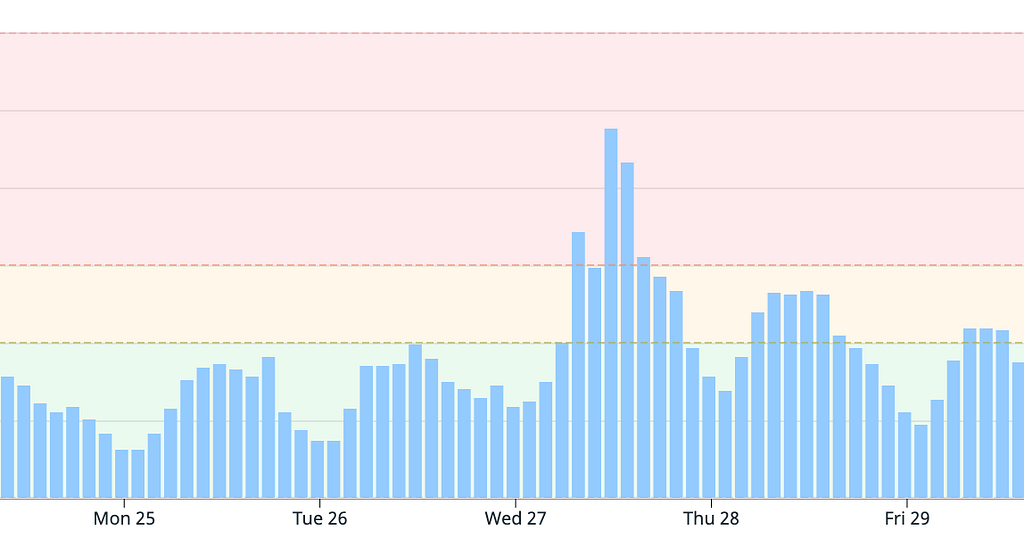
On the morning of October 27th PT, we experienced a significant increase in traffic. As traffic increased, our engineers were alerted about elevated error rates appearing across a number of services.
The following functionality was affected:
Logged-out experience: users that were not logged in experienced errors when visiting coinbase.com or our mobile apps.
Coinbase Pro: users were temporarily unable to log in to Coinbase Pro.
Transfers: There was a higher rate of cancelled and refunded transfers during this time, as well as delays in processing on-chain money movements. Users may have been unable to see their latest transfer history.
Root Cause Analysis
These issues were caused by two separate but related outages. Both were triggered by system bottlenecks caused by the elevated traffic.
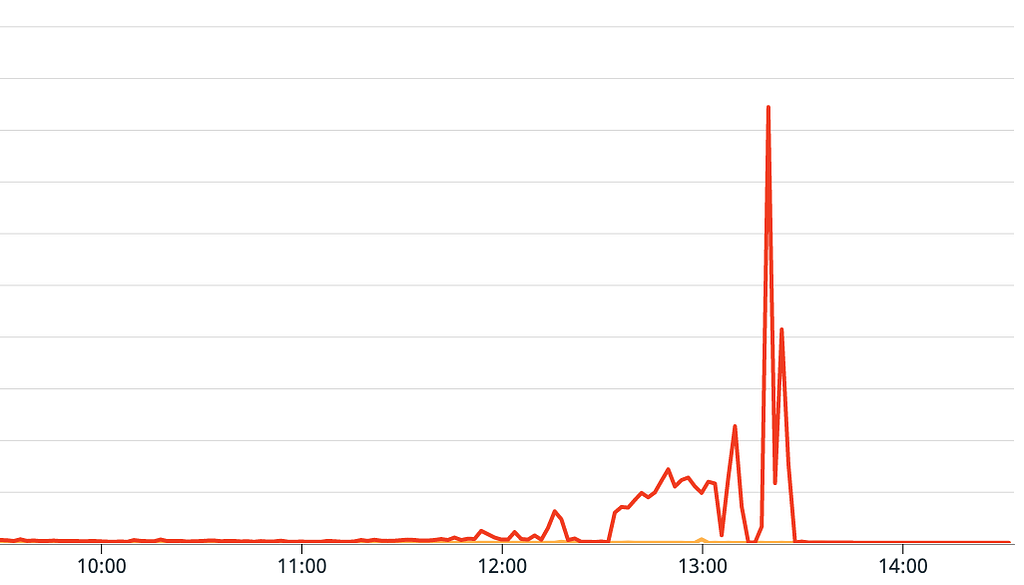
Traffic to Coinbase — 10/27/2021
In the first outage, we observed traffic patterns that were several times greater than previous peaks. This increase in traffic began to overload a datastore responsible for our rewards functionality. As latency increased on this database, related services became saturated and started to deplete resources as well. This resulted in a chain of failures and a more widespread outage.
Query capacity to key database cluster
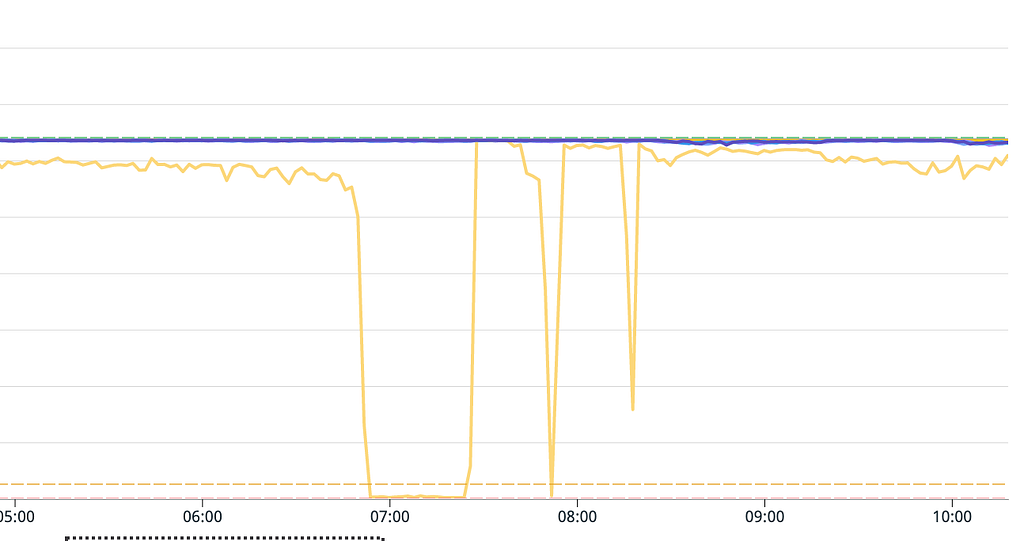
The second outage was also triggered by a spike in traffic levels. In the early afternoon, engineers were alerted that our payment processing was being similarly overloaded. Unfortunately, an automated maintenance event that was already underway slowed our ability to scale this cluster up to meet with demand, and a set of failures similar to those that occurred during the first outage followed.
Elevated query latency for Payments cluster
In this instance, the servers that power our logged-out experience were also affected. As these servers became overwhelmed, they were unable to serve new traffic and were ultimately marked by our load balancer as unhealthy and removed from its pool, causing coinbase.com to become unavailable to users who were logged out or who were attempting to log in. Other impacted functionality included the ability to buy, sell, and trade in both Coinbase’s retail application as well as Coinbase Pro.
At 2:32pm PT, our services returned to normal operation.
Resolution & Improvements
For the first outage, once the caching changes were deployed, the rewards database was scaled up, and additional replicas became available. Afterwards, our system was able to resume normal operation.
To resolve the second outage, we upgraded the under-capacity payments cluster to a larger instance size and introduced additional read-only replicas.
To prevent similar issues in the future, we are taking several additional actions:
Reorganizing our largest services: we will continue to shard and isolate our largest services to avoid hitting limits like those mentioned previously.
Enhanced load testing: we’re enhancing our load testing framework to be more representative of new traffic patterns that we saw during this event.
Additional scaling: we are further scaling several of our databases that we observed operating close to limits at Wednesday’s elevated traffic levels.
We take the uptime and performance of our infrastructure very seriously, and we’re working hard to support the millions of customers that choose Coinbase to manage their cryptocurrency. If you’re interested in solving scaling challenges like those presented here, come work with us.
Cybersecurity awareness month is coming to a close, but good security hygiene is a smart investment all year round. As crypto becomes more mainstream, cybercriminals who target crypto holders are also getting more creative and persistent. That’s why Coinbase’s security team has put together a simple guide for protecting your crypto and all the other valuable data you store online. Here are the takeaways.
Use a password manager. Humans are really bad at remembering passwords, which is why too many of us choose simple phrases and repeat them across multiple websites. Password managers (like 1password and Dashlane) generate strong, secure passwords and store them for you — no memorization required. Use one. (Want to see if your passwords have been exposed by a known data breach? Check out haveibeenpwned.com.)
Enable 2-factor authentication (2FA). 2FA can protect an account even if a hacker steals your password. There are several types of 2FA, ranging from less secure (SMS-based, where a verification code is sent via text message) to more secure (an app that generates verification codes like Google Authenticator) to most secure (a hardware security key like a Yubikey). We strongly recommend choosing a stronger method than SMS, because hackers can steal texts with a common method called “SIM-swapping” — in which your phone number is transferred to another device. If no other option is available, enable SMS 2FA — but if that’s not possible, consider using a different service.
Protect your seed phrase. A seed phrase is a string of 12 to 24 words that is literally the key to a non-custodial crypto wallet like Coinbase Wallet or MetaMask. Anyone with access to your seed phrase has access to the crypto in that wallet. If you lose or delete your wallet, you can restore it with your seed phrase — but if you lose your seed phrase, you lose your crypto. (For many users, keeping crypto in the “hosted wallet” that comes with every Coinbase account is a more convenient option. You can add another layer of security without having to manage seed phrases by moving some crypto into a Coinbase Vault.)
Don’t click that link! One of the most commonly used tactics by cybercriminals is SMS phishing. Phishing is a type of online attack in which a cybercriminal impersonates a legitimate entity or authority and attempts to deceive their target into clicking on a malicious link or attachment.
Be wary of “airdrops.” If you’re a fan of NFTs or DeFi, you’ve probably encountered airdrops — in which a project rewards early adopters by sending tokens to their wallets. But in recent weeks, our security team has been tracking an ongoing phishing campaign involving airdrops. In the scam, randomly airdropped tokens appear in your wallet. If you try to interact with them, you’re prompted to connect your wallet to a website that looks like a DeFi app — but actually gives hackers permission to drain your holdings. To protect yourself, don’t interact with airdropped tokens from unknown sources, don’t connect your wallet to websites advertised by airdropped tokens, and don’t keep too much crypto in a wallet you regularly use to interact with crypto apps.
Don’t make yourself a target. Don’t brag about your cryptocurrency holdings online, just like you wouldn’t advertise inheriting $50 million. Review your online presence and see how much personal information someone could learn about you to steal your identity. (The good folks at Consumer Reports put together this self assessment.)
Security incidents aren’t unique to crypto, but when they happen, Coinbase works with industry partners to mitigate negative exposure. By following these few simple guidelines on protecting your crypto, you can also play an important role in not only protecting yourself but also the entire crypto community.
Around the Blockfrom Coinbase Ventures sheds light on key trends impacting the crypto ecosystem. In this edition, the Ventures team provides an update on Coinbase Ventures activity in 2021-Q3, and key learnings from around the industry.
Coinbase Ventures (or “Ventures”) has grown into one of the most active VC investors in crypto by deal count. In Q3, Ventures made a record 49 investments, averaging a new deal every ~1.8 days. This is up from 28 investments made in Q2, and 24 in Q1. As of Q3 2021, the Ventures portfolio size stands at over 200+ companies and projects.
On a cumulative basis, 90% of the capital invested by Ventures has been deployed in 2021 YTD, reflecting the accelerated pace of Coinbase Ventures in its fourth year of operation. 50% of the new unique “logos” in the portfolio have also come in 2021.
Motivation & philosophy
Coinbase Ventures primary mandate is to support the growing crypto ecosystem. As such, we invest broadly across the space in strong entrepreneurs driving crypto forward. We want the crypto ecosystem to bloom and are not focused exclusively on specific outcomes (as is typical with corporate venture capital).
Ultimately, we see crypto as a rising tide, and growth in the ecosystem lifts all boats — Coinbase included. Traditional strategic benefits, such as commercial partnerships and potential M&A, are great, but we view them as icing on the cake.
Investment Categories
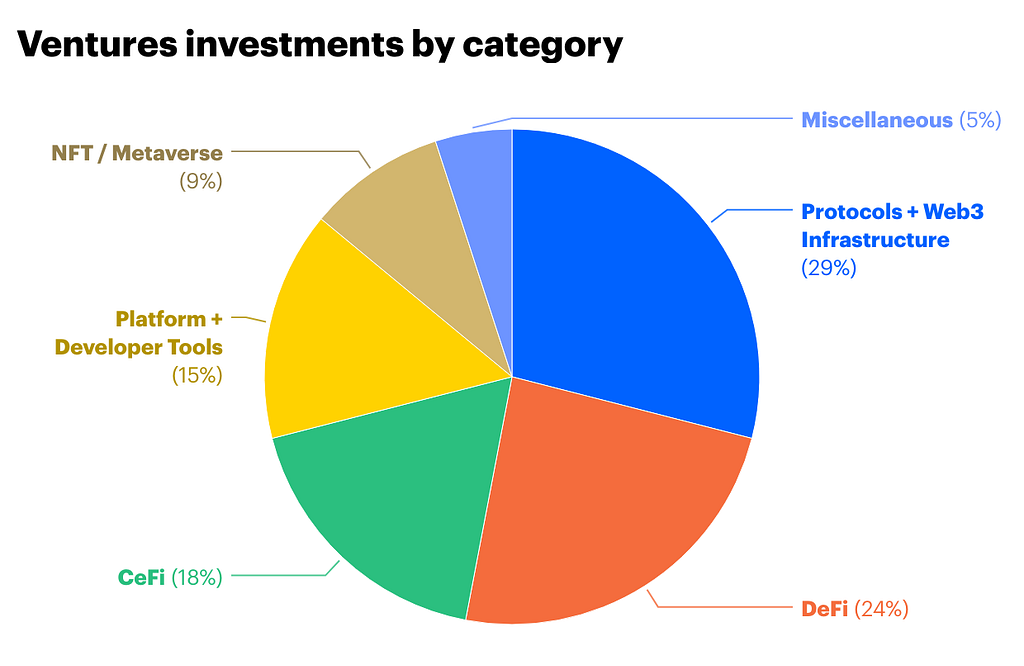
Coinbase Ventures investments range from six-figure seed deals to multi-million dollar growth rounds. There are many ways to slice our investments, but at the highest level we break down the market across the following categories: Protocols + Web3 infrastructure, DeFi, CeFi, Platform + Developer Tools, NFT / Metaverse, and Miscellaneous.
Our current distribution of total investments by company is as follows:
Key Themes & Learnings
*Coinbase Ventures portfolio company
In our most active quarter to date, we saw heavy development across centralized finance (CeFi) in the United States, Layer-1/Layer-2, cross-chain protocols, as well as Web3 tooling. Here’s some of the major themes we observed.
Regulators and centralized players waded deeper into the crypto waters
Regulatory bodies made their presence more widely known in Q3, as the SEC and Treasury Department in the US, and the Financial Action Task Force (FATF) internationally, all stepped up engagement across the crypto ecosystem. This has introduced some forms of regulatory risk for early stage protocols and teams. On the flip side, the largest cap asset scored positive tailwinds in the form of the BTC Futures ETF approval which we believe will allow latent capital to enter crypto markets, leading to significant volumes, inflows, and interest.
Web 2.0 companies like Square, Twitter, Stripe, and Tik Tok also expanded their crypto strategies in Q3. Square announced a Bitcoin based platform for financial services, Twitter revealed future BTC Lightning and NFT integrations, and Stripe announced its return to crypto with a new dedicated crypto team. Tik Tok announced a partnership with ImmutableX* to launch a creator-led NFT collection.
Meanwhile, banks, fintechs, and broker dealers moved to further integrate crypto into their product offerings, enabled by Coinbase Prime, Coinbase Cloud and other third party platforms. All in all, the crypto industry made tremendous strides with respect to maturation and institutional adoption over the quarter.
The multichain ecosystem hit its stride
Following years of development on solutions designed to alleviate bottlenecks on Ethereum, scaling is finally here with a range of Layer-1 and Layer-2 ecosystems taking off. The majority of the current traction is on solutions leveraging EVM (Ethereum Virtual Machine) compatibility, allowing users and developers to migrate to new environments with relatively low switching costs. Users can access EVM compatible L1s like Avalanche, or sidechains/L2s like Polygon*/Arbitrum*/Optimism* with their existing wallets. Solidity smart contracts can also be generally copy + pasted to any EVM compatible L1/L2, which has led to implementations of popular DeFi applications across multiple chains.
As CeFi exchanges have been slow to integrate with these new L1s/L2s, we saw traction across newly launched cross-chain bridges. These bridges facilitated the movement of billions in funds from Ethereum to various L1s/L2s.
While EVM compatible applications written in Solidity saw the most traction on L1s and L2s in Q3, other ecosystems are bringing more expressive programmability to the table. New primitives focused on more familiar programming languages like Rust (Solana, Polkadot), Golang (Cosmos), and Move (Facebook Diem*, Flow*) may usher in a wave of new Web 2.0 developers to the industry.
Better Web3 UX is on the way
In Q3 we saw further development of Web3 tooling that will simplify the experience of Web3 interactions. XMTP* is spearheading a messaging standard across Web3 addresses. Spruce* is standardizing “OAuth” (open authorization), which will allow users to securely share digital credentials, private files, and sensitive media with Web 3 applications. Snapshot* is making it simple to access governance forums and decisions across Dapps.
Meanwhile, a tremendous amount of work is being done to create added security for Web3 applications. OpenZeppelin’s decentralization effort, Forta*, is making progress on real-time security monitoring of smart contracts with the goal of providing more transparency around smart contract code execution, detection of bugs, and eventually, the prevention of hacks in real-time. Similarly, Certik* is providing a “fast-and-easy” automated audit tool to help Dapps go-to-market more quickly.
Simultaneously, the DAO tech stack continues to evolve, with the technical and legal formation of on-chain communities beginning to take hold. Syndicate* (among others) aims to be the “AngelList of crypto” through the creation of a decentralized investing protocol and social network.
NFT 2.0 & crypto gaming took flight
Q3 also saw a ton of development focused on NFT creator tools that will ultimately broaden the scope of NFT use cases and audiences while creating new social features.
Meanwhile, NFT based gaming continued to accelerate led by Axie Infinity, as its play-to-earn model took hold in emerging markets (Philippines, Brazil, India among others) attracting 2M DAUs and generating over $2B in revenue. Loot Project also captivated the industry by introducing an inverted model for game development. This was done by first releasing NFT based game assets to the public in order to bootstrap a community and incentivize further development.
Stay tuned
Stayed tuned for more insights and updates from the Coinbase Ventures team in the future. Also check out previous editions of Around The Block that you may have missed:
Starting Today, Wednesday October 27,transferKRL, LCX, SUKU and TRACinto your Coinbase Pro account ahead of trading. Support forKRL, LCX, SUKU and TRACwill generally be available in Coinbase’s supported jurisdictions with certain exceptions as indicated in each asset pagehere. Trading will begin on or after 9AM Pacific Time (PT)Thursday October 28, if liquidity conditions are met.
Starting Today, Wednesday October 27 we will begin accepting inbound transfers of KRL, LCX, SUKU and TRAC to Coinbase Pro. Trading will begin on or after 9AM Pacific Time (PT)Thursday October 28, if liquidity conditions are met.
Once sufficient supply of KRL, LCX, SUKU and TRAC is established on the platform, trading on our KRL-USD, KRL-USDT, KRL-EUR, LCX-USD, LCX-USDT, LCX-EUR, SUKU-USD, SUKU-USDT, SUKU-EUR, TRAC-USD, TRAC-USDT and TRAC-EURorder books will launch in three phases, post-only, limit-only and full trading. If at any point one of the new order books does not meet our assessment for a healthy and orderly market, we may keep the book in one state for a longer period of time or suspend trading as per our Trading Rules.
We will publish tweets from our Coinbase Pro Twitter account as each order book moves through the phases.
Kryll (KRL) is an Ethereum token that powers Kryll, a platform for automated trading strategies. Kryll users can browse, create, and backtest trading strategies while using KRL to pay for their activity on the platform.
LCX (LCX) is an Ethereum token used to pay for fees on LCX Exchange, a centralized exchange for security tokens, token sales, and cryptocurrencies. LCX is also used to power other LCX products such as the LCX Terminal, which lets users trade across multiple exchanges, and the DeFi Terminal, which offers advanced charting and limit orders built on top of Uniswap.
SUKU (SUKU) is an Ethereum token that powers the SUKU Platform, a blockchain-based ecosystem that aims to make supply chains more transparent. SUKU tokens can be used for platform governance and to reward users and SUKU node operators. SUKU Platform is also developing applications for DeFi lending and NFT marketplaces.
OriginTrail (TRAC) is an Ethereum token that powers OriginTrail, which describes itself as a “decentralized knowledge graph.” OriginTrail is used to discover, manage, and store data for everything from supply chain tracking to verifying art, diplomas, and business certifications. TRAC token is used to pay for data processing and storage on the network.
KRL, LCX, SUKU and TRAC are not yet available on Coinbase.com or via our Consumer mobile apps. We will make a separate announcement if and when this support is added.
You can sign up for a Coinbase Pro account here to start trading. For more information on trading KRL, LCX, SUKU and TRAC on Coinbase Pro, visit our support page.
### Please note:Coinbase Ventures may be an investor in the crypto projects mentioned here, and additionally, Coinbase may hold such tokens on its balance sheet for operational purposes. A list of Coinbase Ventures investments is available athttps://ventures.coinbase.com/. Coinbase intends to maintain its investment in these entities for the foreseeable future and maintains internal policies that address the timing of permissible disposition of any related digital assets, if applicable. All assets, regardless of whether Coinbase Ventures holds an investor or Coinbase holds for operational purposes, are subject to the same strict review guidelines and review process. This website contains links to third-party websites or other content for information purposes only (“Third-Party Sites”). The Third-Party Sites are not under the control of Coinbase, Inc., and its affiliates (“Coinbase”), and Coinbase is not responsible for the content of any Third-Party Site, including without limitation any link contained in a Third-Party Site, or any changes or updates to a Third-Party Site. Coinbase is not responsible for webcasting or any other form of transmission received from any Third-Party Site. Coinbase is providing these links to you only as a convenience, and the inclusion of any link does not imply endorsement, approval or recommendation by Coinbase of the site or any association with its operators.
Crypto is a new type of asset. Besides potential day to day or hour to hour volatility, each crypto asset has unique features. Make sure you research and understand individual assets before you transact.
As a part of our mission to build a safe and open financial system, we actively monitor for any security threats not only to Coinbase but to the crypto ecosystem as a whole. As we have discussed in our previous blog post on industry-wide crypto security threats, malicious threats against any crypto user or business are bad for the industry. With this community mindset, we do our best to inform and to defend our community from bad actors.
Over the past month, Coinbase Threat Intelligence, Special Investigations, and Global Intelligence teams have been tracking an ongoing phishing campaign on Ethereum, Polygon, Binance Smart Chain, and other EVM-compatible platforms which has unfortunately resulted in the theft of more than $15M in various crypto assets to date. The phishing campaign does not affect customers who custody funds on Coinbase.com. However, anyone who uses self-custody wallets (e.g. Coinbase Wallet, Metamask, etc.) may be at risk.
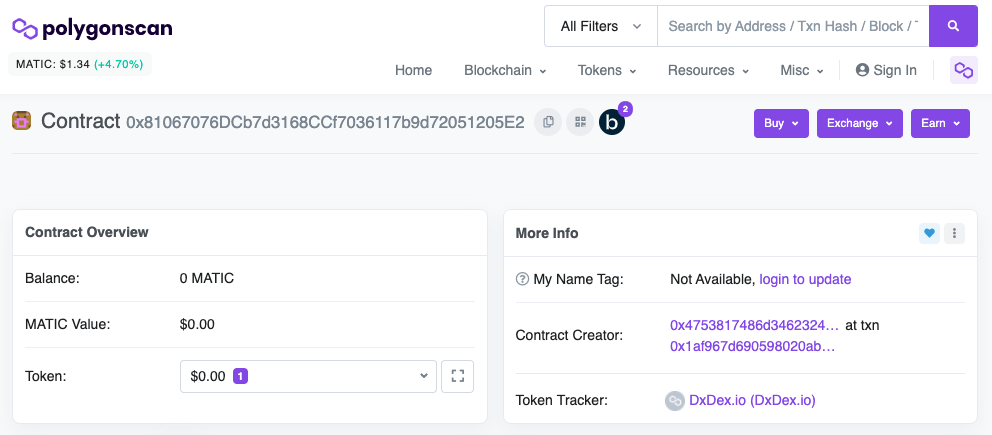
The campaign works by airdropping fictitious coins into victim wallets and enticing them to visit specially-crafted malicious websites. Below is an example of one such coin:
Source: Polygonscan
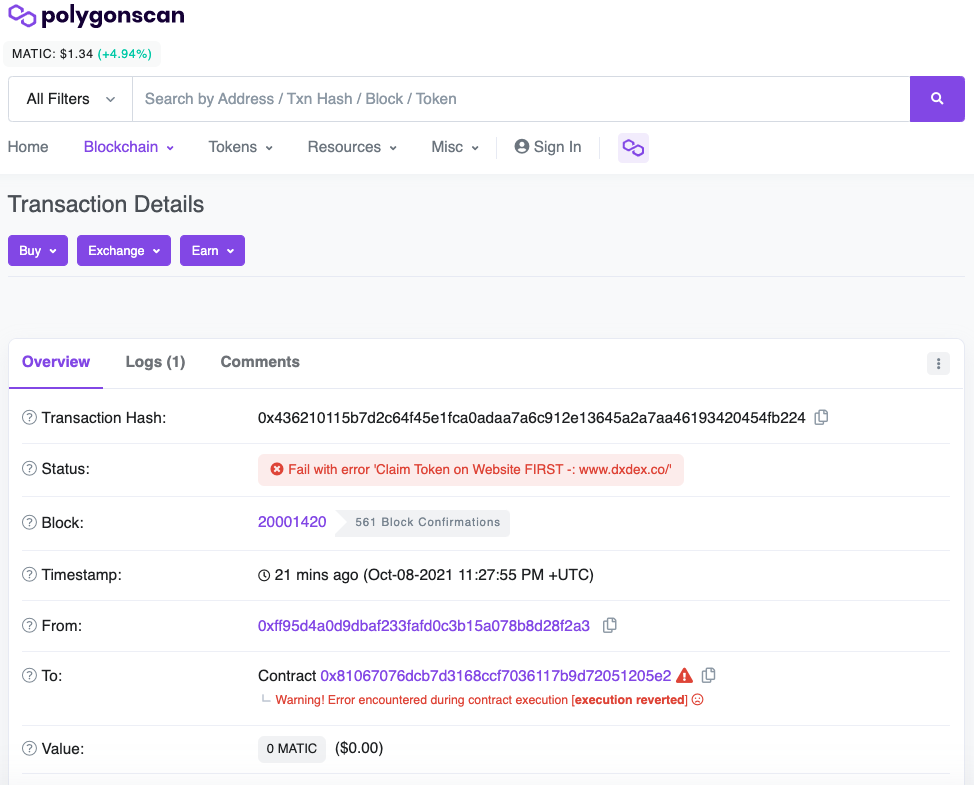
When users attempt to interact with the airdropped tokens such as transferring them to a Decentralized Exchange (DEX), they are presented with an error message encouraging them to visit a malicious phishing website:
Source: Polygonscan
The website presents users with a Decentralized Application (DApp) interface supposedly meant to connect their wallets and approve trading of the airdrop tokens. However, when users approve any transactions on the phishing website, in reality they are unknowingly approving a transfer of their personal tokens to the scammers.
Source: Phishing Site
The scammers change airdrop token names and phishing websites frequently to evade blocklists; however, they still use the same tactics to steal tokens using fake airdrops and malicious Dapps. Nevertheless, you can take the following security steps to defend your assets:
Be wary of airdrop tokens received from an unknown source. It is highly likely these unsolicited tokens are part of a phishing campaign.
Do not visit or connect self-custody wallets to any websites advertised by airdropped tokens through error messages, token names, or other methods.
Do not interact with airdropped tokens (e.g. approving, transferring, swapping, etc.). As annoying as it sounds, it’s best to just leave them sitting in your wallet.
Do not hold high value assets in the same wallet used to regularly interact with Dapps. Use cold storage or custodial solutions such freely available Coinbase Vault or Custody.
Coinbase is working with industry partners to help limit the damage caused by the scam and we are planning to publish a more detailed analysis of the campaign in the near future.
Starting today, Assemble Protocol (ASM) is available on Coinbase.com and in the Coinbase Android and iOS apps. Coinbase customers can now trade, send, receive, or store ASM, KRL, LCX and TRAC in most Coinbase-supported regions, with certain exceptions indicated in each asset page here. Trading for these assets is also supported on Coinbase Pro.
Assemble Protocol (ASM) is an Ethereum token that powers Assemble, a platform where users and merchants can aggregate, manage, and spend reward points. On Assemble, point providers and retailers can run special events or promotions, providing benefits like discounts for ASM
One of the most common requests we hear from customers is to be able to buy and sell more cryptocurrencies on Coinbase. We announced a process for listing assets, designed in part to accelerate the addition of more cryptocurrencies. We are also investing in new tools to help people understand and explore cryptocurrencies. We launched informational asset pages (see ASM), as well as a new section of the Coinbase website to answer common questions about crypto.
Customers can sign up for a Coinbase account here to buy, sell, convert, send, receive, or store e Coinbase Android and iOS apps. Coinbase customers can now trade, send, receive, or store ASM today.
###
Please note:Coinbase Ventures may be an investor in the crypto projects mentioned here, and additionally, Coinbase may hold such tokens on its balance sheet for operational purposes. A list of Coinbase Ventures investments is available athttps://ventures.coinbase.com/. Coinbase intends to maintain its investment in these entities for the foreseeable future and maintains internal policies that address the timing of permissible disposition of any related digital assets, if applicable. All assets, regardless of whether Coinbase Ventures holds an investor or Coinbase holds for operational purposes, are subject to the same strict review guidelines and review process.
This website contains links to third-party websites or other content for information purposes only (“Third-Party Sites”). The Third-Party Sites are not under the control of Coinbase, Inc., and its affiliates (“Coinbase”), and Coinbase is not responsible for the content of any Third-Party Site, including without limitation any link contained in a Third-Party Site, or any changes or updates to a Third-Party Site. Coinbase is not responsible for webcasting or any other form of transmission received from any Third-Party Site. Coinbase is providing these links to you only as a convenience, and the inclusion of any link does not imply endorsement, approval or recommendation by Coinbase of the site or any association with its operators.
Crypto is a new type of asset. Besides potential day to day or hour to hour volatility, each crypto asset has unique features. Make sure you research and understand individual assets before you transact.
By Joe Waltman, Group Product Manager, GiveCrypto.org
Hope everyone had a wonderful summer. GiveCrypto just concluded its first full quarter as a part of Coinbase, so we wanted to share an update with those who are following our progress. As always, we’d love to hear from you.
Coinbase Integrations
As mentioned in previous updates, we’ve been experimenting with ways to make it as easy as possible for Coinbase users to donate to charity. Coinbase has over 68 million verified users, many of whom transact significant sums of crypto on a regular basis. We see a golden opportunity to facilitate charitable donations inside this ecosystem.
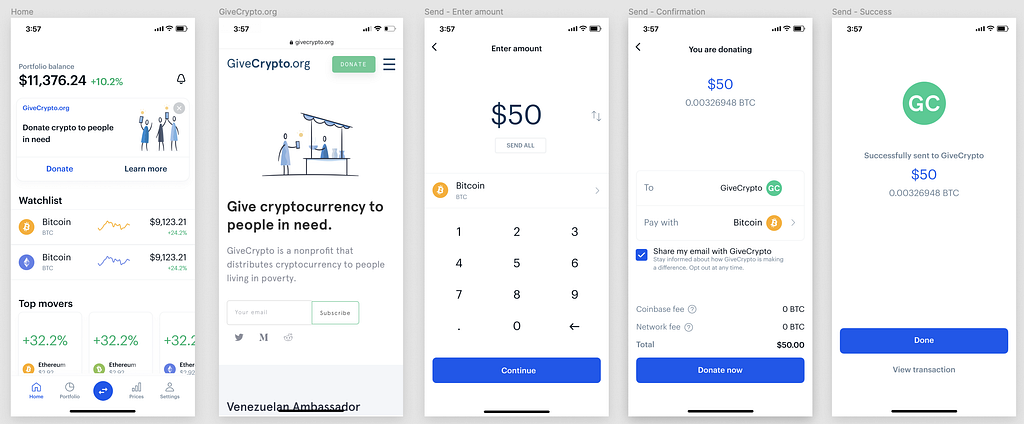
Example of the previous, multi-step flow required to donate in the Coinbase app
We have tried to integrate a donation function into Coinbase’s UI before, but we limited those past attempts to banners on Coinbase’s web and mobile properties. Those banners didn’t drive much traffic, and when they did, the user would have to go through a multi-step flow to donate. Because of that, donation volume has been relatively low.
Though these modest attempts weren’t the most effective, we chose to take this cautious approach for good reason: We wanted to be sure that we didn’t confuse users or impact Coinbase conversion rates. We also wanted to minimize the technical complexity of integrating a more prominent donation function until we and Coinbase were fully ready to do so.
We now understand that the real opportunity lies in integrating donation options into primary transactional flows like buy and sell. From integrating back-end services to solving a variety of other technical challenges, we know this won’t be simple. But finding a way for Coinbase users to seamlessly donate crypto would be a big accomplishment — not just for us, but also for the crypto community.
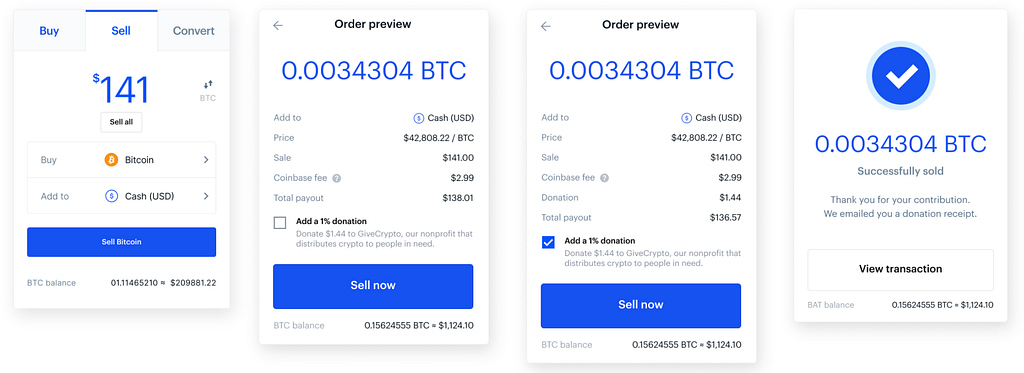
Mock-up of a donate one percent integration in the sell flow
The current plan is to experiment with a ‘donate one percent of your transaction’ mechanic within Coinbase’s “sell” flow. At first, only a small percentage of Coinbase users will be exposed to this experiment as we observe how they impact key guardrail metrics. We’ll then analyze those results to determine our path forward.
As an aside, I’d like to take this opportunity to express how exciting it is to be involved in the innovation we’re witnessing in this industry. We have long believed that Coinbase has the potential to become a leader in the world of philanthropy, and our experience working together has only reinforced that belief. Perhaps one day we’ll be able to promote the verb “give” to a first-class citizen, so to speak, equal to the likes of “buy” and “sell.”
Ambassador Program
Before we give an update on the current status of the ambassador program, it probably makes sense to review the program’s history.
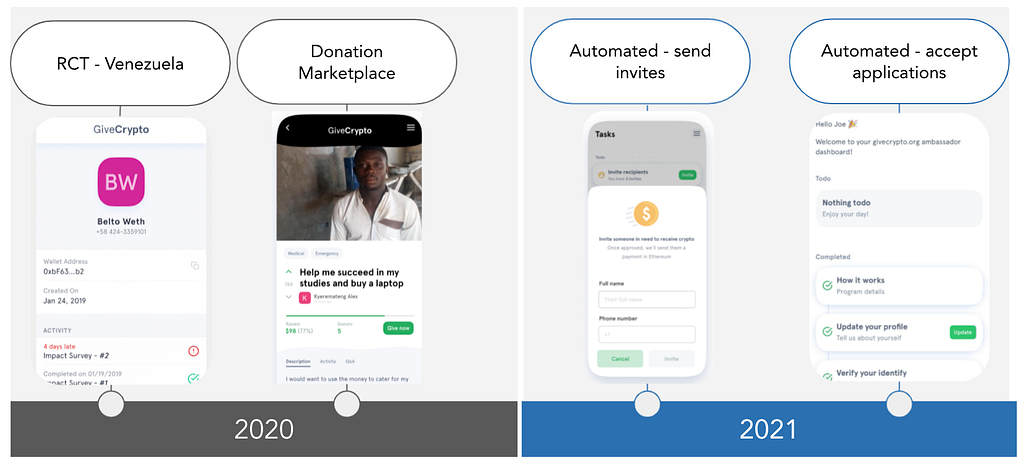
We launched the ambassador program in 2019 and spent the first half of 2020 implementing an RCT in Venezuela. We spent the second half of 2020 experimenting with a crypto donation marketplace that would be similar to GoFundMe or DonorsChoose but fully crypto-based. Ultimately, this didn’t accomplish what we hoped it would, so we decided to pivot back to the ambassador program in early 2021.
Our goal for 2021 was to automate as much of the program as possible so that it could be scaled in the near future. To minimize the manual workload, we started out by automating most of the program’s operational components, but we only invited people we felt we could trust. Giving away money on the internet tends to attract scammers, and we needed some assurances that people would use our funds in good faith.
We quickly learned that it would be hard to recruit ambassadors at scale if we only acquired them through high-trust channels such as labor marketplaces and social media networks. Once we realized that we would need to cast a wider net, we launched a version of the ambassador program that allows anybody to apply.
Before launching this updated version of the ambassador program, we developed fraud detection metrics designed to mitigate Sybil attacks. In simple terms, this helped us ensure that the ambassadors who applied to the program were who they said they were.
In the same update, we also tried to devise a trust score, which is a way of programmatically identifying which ambassadors are acting in good faith. We defined a good-faith ambassador as one who meets two criteria: they select recipients who are actually in need; and their recipients actually do what they say they’ll do with the funds.
Once we recruited a few hundred ambassadors, we found we needed to augment the automated scoring with significant manual investigation and intervention to thwart bad-faith behavior. We’ve thus realized that until our automations have undergone further maturation and validation, we’ll need to filter down the incoming audience.
For these reasons, we have decided to make the following changes:
Focus on the following countries: Venezuela, Colombia and El Salvador
Hire a manager in each country, whose primary job is to recruit trusted ambassadors. We will closely monitor these ambassadors and use the data to inform our automation process.
Monitor the activities of each ambassador’s recipients. We plan to give “good” ambassadors more invites and to extend the length of payment periods for “good”’ recipients.
Begin measuring the impact of donations via self-reported questionnaires and spot checks, which will be overseen by the local manager as well as high-quality ambassadors.
This revised approach will provide the following benefits.
Provide locations with different characteristics (i.e. inflation, crypto adoption, smartphone penetration and regulatory acceptance) but still have high levels of need and minimal logistical challenges (i.e. timezone and localization)
Reduce our team’s need to manually supervise the program
Improve the ratio of high-quality ambassadors signing up
Allow us to facilitate redemption options for recipients, such as stores and cash-out partners
Train and validate our data models on what good behavior looks like across various geographies
We have already started rolling out components of this plan and look forward to more enhancements in Q4. Between this program’s growth and the new donation options, we’re thrilled to see our work paying off.
GiveCrypto Q3 Update was originally published in The Coinbase Blog on Medium, where people are continuing the conversation by highlighting and responding to this story.
Starting today, Bounce (AUCTION) is available on Coinbase.com and in the Coinbase Android and iOS apps. Coinbase customers can now trade, send, receive, or store AUCTION in most Coinbase-supported regions, with certain exceptions indicated in each asset page here. Trading for these assets is also supported on Coinbase Pro.
Bounce (AUCTION) is an Ethereum token that powers Bounce, a decentralized auction protocol for token and NFT sales. AUCTION supports incentives on the protocol, provides benefits and governance rights for holders, and is used to pay for certified listings.
One of the most common requests we hear from customers is to be able to buy and sell more cryptocurrencies on Coinbase. We announced a process for listing assets, designed in part to accelerate the addition of more cryptocurrencies. We are also investing in new tools to help people understand and explore cryptocurrencies. We launched informational asset pages (see AUCTION ), as well as a new section of the Coinbase website to answer common questions about crypto.
Customers can sign up for a Coinbase account here to buy, sell, convert, send, receive, or store e Coinbase Android and iOS apps. Coinbase customers can now trade, send, receive, or store AUCTION today.
###
Please note:Coinbase Ventures may be an investor in the crypto projects mentioned here, and additionally, Coinbase may hold such tokens on its balance sheet for operational purposes. A list of Coinbase Ventures investments is available athttps://ventures.coinbase.com/. Coinbase intends to maintain its investment in these entities for the foreseeable future and maintains internal policies that address the timing of permissible disposition of any related digital assets, if applicable. All assets, regardless of whether Coinbase Ventures holds an investor or Coinbase holds for operational purposes, are subject to the same strict review guidelines and review process.
This website contains links to third-party websites or other content for information purposes only (“Third-Party Sites”). The Third-Party Sites are not under the control of Coinbase, Inc., and its affiliates (“Coinbase”), and Coinbase is not responsible for the content of any Third-Party Site, including without limitation any link contained in a Third-Party Site, or any changes or updates to a Third-Party Site. Coinbase is not responsible for webcasting or any other form of transmission received from any Third-Party Site. Coinbase is providing these links to you only as a convenience, and the inclusion of any link does not imply endorsement, approval or recommendation by Coinbase of the site or any association with its operators.
Crypto is a new type of asset. Besides potential day to day or hour to hour volatility, each crypto asset has unique features. Make sure you research and understand individual assets before you transact.
Starting Today, Wednesday October 20,transferASMinto your Coinbase Pro account ahead of trading. Support forASMwill generally be available in Coinbase’s supported jurisdictions with certain exceptions as indicated in each asset pagehere. Trading will begin on or after 9AM Pacific Time (PT)Thursday October 21, if liquidity conditions are met.
Starting Today, Wednesday October 20 we will begin accepting inbound transfers of ASM to Coinbase Pro. Trading will begin on or after 9AM Pacific Time (PT)Thursday October 21, if liquidity conditions are met.
Once sufficient supply of ASM is established on the platform, trading on our ASM-USD and ASM-USDTorder books will launch in three phases, post-only, limit-only and full trading. If at any point one of the new order books does not meet our assessment for a healthy and orderly market, we may keep the book in one state for a longer period of time or suspend trading as per our Trading Rules.
We will publish tweets from our Coinbase Pro Twitter account as each order book moves through the phases.
Assemble Protocol (ASM) is an Ethereum token that powers Assemble, a platform where users and merchants can aggregate, manage, and spend reward points. On Assemble, point providers and retailers can run special events or promotions, providing benefits like discounts for ASM
ASM is not yet available on Coinbase.com or via our Consumer mobile apps. We will make a separate announcement if and when this support is added.
You can sign up for a Coinbase Pro account here to start trading. For more information on trading ASM on Coinbase Pro, visit our support page.
### Please note:Coinbase Ventures may be an investor in the crypto projects mentioned here, and additionally, Coinbase may hold such tokens on its balance sheet for operational purposes. A list of Coinbase Ventures investments is available athttps://ventures.coinbase.com/. Coinbase intends to maintain its investment in these entities for the foreseeable future and maintains internal policies that address the timing of permissible disposition of any related digital assets, if applicable. All assets, regardless of whether Coinbase Ventures holds an investor or Coinbase holds for operational purposes, are subject to the same strict review guidelines and review process. This website contains links to third-party websites or other content for information purposes only (“Third-Party Sites”). The Third-Party Sites are not under the control of Coinbase, Inc., and its affiliates (“Coinbase”), and Coinbase is not responsible for the content of any Third-Party Site, including without limitation any link contained in a Third-Party Site, or any changes or updates to a Third-Party Site. Coinbase is not responsible for webcasting or any other form of transmission received from any Third-Party Site. Coinbase is providing these links to you only as a convenience, and the inclusion of any link does not imply endorsement, approval or recommendation by Coinbase of the site or any association with its operators.
Crypto is a new type of asset. Besides potential day to day or hour to hour volatility, each crypto asset has unique features. Make sure you research and understand individual assets before you transact.
Starting today, ARPA Chain (ARPA) and Perpetual Protocol (PERP) are available on Coinbase.com and in the Coinbase Android and iOS apps. Coinbase customers can now trade, send, receive, or store ARPA and PERP in most Coinbase-supported regions, with certain exceptions indicated in each asset page here. Trading for these assets is also supported on Coinbase Pro.
ARPA Chain (ARPA) is an Ethereum token that powers ARPA Chain, a computation network that enables privacy-preserving smart contracts, data storage, and scalable off-chain transactions. The ARPA token can be used to pay for data and computation in addition to governing the future of the network.
Perpetual Protocol (PERP) is an Ethereum token that powers Perpetual Protocol, a decentralized exchange for perpetual contracts. Using perpetual contracts, users can open leveraged long or short trading positions for a variety of assets.
One of the most common requests we hear from customers is to be able to buy and sell more cryptocurrencies on Coinbase. We announced a process for listing assets, designed in part to accelerate the addition of more cryptocurrencies. We are also investing in new tools to help people understand and explore cryptocurrencies. We launched informational asset pages (see ARPAandPERP), as well as a new section of the Coinbase website to answer common questions about crypto.
Customers can sign up for a Coinbase account here to buy, sell, convert, send, receive, or store e Coinbase Android and iOS apps. Coinbase customers can now trade, send, receive, or store ARPA and PERP today.
###
Please note:Coinbase Ventures may be an investor in the crypto projects mentioned here, and additionally, Coinbase may hold such tokens on its balance sheet for operational purposes. A list of Coinbase Ventures investments is available athttps://ventures.coinbase.com/. Coinbase intends to maintain its investment in these entities for the foreseeable future and maintains internal policies that address the timing of permissible disposition of any related digital assets, if applicable. All assets, regardless of whether Coinbase Ventures holds an investor or Coinbase holds for operational purposes, are subject to the same strict review guidelines and review process.
This website contains links to third-party websites or other content for information purposes only (“Third-Party Sites”). The Third-Party Sites are not under the control of Coinbase, Inc., and its affiliates (“Coinbase”), and Coinbase is not responsible for the content of any Third-Party Site, including without limitation any link contained in a Third-Party Site, or any changes or updates to a Third-Party Site. Coinbase is not responsible for webcasting or any other form of transmission received from any Third-Party Site. Coinbase is providing these links to you only as a convenience, and the inclusion of any link does not imply endorsement, approval or recommendation by Coinbase of the site or any association with its operators.
Crypto is a new type of asset. Besides potential day to day or hour to hour volatility, each crypto asset has unique features. Make sure you research and understand individual assets before you transact.
Facebook has chosen Coinbase as its custody partner for its pilot of Novi, a new digital wallet that enables people to send and receive money abroad instantly, securely, and with no fees.
For the pilot, Coinbase is supporting Novi via Coinbase Custody, which keeps user funds secure with our proprietary, fully segregated cold storage capability for managing private keys.
Novi users who can participate in the pilot can acquire Pax Dollar (USDP) through their Novi account, which Novi will hold on deposit with Coinbase Custody. Novi users will then be able to transfer USDP between each other instantaneously.
Novi users’ funds will be held within Coinbase Custody Trust Company, a qualified custodian and a New York limited purpose trust company. Coinbase Custody Trust Company is regulated by the New York Department of Financial Services and is a fiduciary under New York state banking law. Novi users also benefit from Coinbase Custody’s leading insurance program, which includes a $320 million commercial crime policy.
Coinbase Custody is a leading crypto-native platform and custodian that securely manages $180 billion (as of 6/30/21) of crypto assets on its platform. Over the past nine years, Coinbase has developed deep expertise in secure and scalable crypto infrastructure, which we initially built to power our own first party applications. We then productized this infrastructure and now supply our secure infrastructure solutions to the rest of the market. This includes our leading custodial solutions, multi-venue algorithmic trade execution, staking support, financing, defi access, compliance, and market and on-chain data analytics.
We believe that in the future, every company will be a crypto company, including fintech platforms, banks, social media, gaming companies, and consumer brands. Our goal is to arm them with the best tools possible so their own users have a first-class experience and participate in the cryptoeconomy.
To learn more about Coinbase Institutional’s full suite of products and services click here.
Please note:Coinbase currently supports Pax Dollar (USDP) under its original ticker Paxos Standard (PAX) which was rebranded on August 24, 2021.
Starting Today, Monday October 18,transferARPA, AUCTION and PERPinto your Coinbase Pro account ahead of trading. Support forARPA, AUCTION and PERPwill generally be available in Coinbase’s supported jurisdictions with certain exceptions as indicated in each asset pagehere. Trading will begin on or after 9AM Pacific Time (PT)Tuesday October 19, if liquidity conditions are met.
Starting Today, Monday October 18 we will begin accepting inbound transfers of ARPA, AUCTION and PERP to Coinbase Pro. Trading will begin on or after 9AM Pacific Time (PT)Tuesday October 19, if liquidity conditions are met.
Once sufficient supply of ARPA, AUCTION and PERP is established on the platform, trading on our ARPA-USD, ARPA-USDT, ARPA-EUR, AUCTION-USD, AUCTION-USDT, AUCTION-EUR, PERP-USD, PERP-USDT and PERP-EURorder books will launch in three phases, post-only, limit-only and full trading. If at any point one of the new order books does not meet our assessment for a healthy and orderly market, we may keep the book in one state for a longer period of time or suspend trading as per our Trading Rules.
We will publish tweets from our Coinbase Pro Twitter account as each order book moves through the phases.
Bounce (AUCTION) is an Ethereum token that powers Bounce, a decentralized auction protocol for token and NFT sales. AUCTION supports incentives on the protocol, provides benefits and governance rights for holders, and is used to pay for certified listings.
ARPA Chain (ARPA) is an Ethereum token that powers ARPA Chain, a computation network that enables privacy-preserving smart contracts, data storage, and scalable off-chain transactions. The ARPA token can be used to pay for data and computation in addition to governing the future of the network.
Perpetual Protocol (PERP) is an Ethereum token that powers Perpetual Protocol, a decentralized exchange for perpetual contracts. Using perpetual contracts, users can open leveraged long or short trading positions for a variety of assets.
ARPA, AUCTION and PERP are not yet available on Coinbase.com or via our Consumer mobile apps. We will make a separate announcement if and when this support is added.
You can sign up for a Coinbase Pro account here to start trading. For more information on trading ARPA, AUCTION and PERP on Coinbase Pro, visit our support page.
### Please note:Coinbase Ventures may be an investor in the crypto projects mentioned here, and additionally, Coinbase may hold such tokens on its balance sheet for operational purposes. A list of Coinbase Ventures investments is available athttps://ventures.coinbase.com/. Coinbase intends to maintain its investment in these entities for the foreseeable future and maintains internal policies that address the timing of permissible disposition of any related digital assets, if applicable. All assets, regardless of whether Coinbase Ventures holds an investor or Coinbase holds for operational purposes, are subject to the same strict review guidelines and review process. This website contains links to third-party websites or other content for information purposes only (“Third-Party Sites”). The Third-Party Sites are not under the control of Coinbase, Inc., and its affiliates (“Coinbase”), and Coinbase is not responsible for the content of any Third-Party Site, including without limitation any link contained in a Third-Party Site, or any changes or updates to a Third-Party Site. Coinbase is not responsible for webcasting or any other form of transmission received from any Third-Party Site. Coinbase is providing these links to you only as a convenience, and the inclusion of any link does not imply endorsement, approval or recommendation by Coinbase of the site or any association with its operators.
Crypto is a new type of asset. Besides potential day to day or hour to hour volatility, each crypto asset has unique features. Make sure you research and understand individual assets before you transact.
Starting today, BadgerDAO (BADGER) and Rarible (RARI) are available on Coinbase.com and in the Coinbase Android and iOS apps. Coinbase customers can now trade, send, receive, or store BADGER and RARI in most Coinbase-supported regions, with certain exceptions indicated in each asset page here. Trading for these assets is also supported on Coinbase Pro.
BADGER is an Ethereum token that powers Badger DAO, a decentralized autonomous organization (DAO) focused on bringing Bitcoin into the decentralized finance (DeFi) ecosystem on Ethereum and other blockchains. BADGER is primarily used to govern the direction of Badger DAO and its products. BADGER can also be deposited into a Badger vault to boost yield for other deposits.
RARI RARI is an Ethereum token that powers Rarible, a community-owned marketplace for creating, selling, or collecting NFTs. RARI can be earned by using the platform and can be used to curate content and vote on platform upgrades.
One of the most common requests we hear from customers is to be able to buy and sell more cryptocurrencies on Coinbase. We announced a process for listing assets, designed in part to accelerate the addition of more cryptocurrencies. We are also investing in new tools to help people understand and explore cryptocurrencies. We launched informational asset pages (see BADGER and RARI), as well as a new section of the Coinbase website to answer common questions about crypto.
Customers can sign up for a Coinbase account here to buy, sell, convert, send, receive, or store e Coinbase Android and iOS apps. Coinbase customers can now trade, send, receive, or store BADGER and RARI today.
###
Please note:Coinbase Ventures may be an investor in the crypto projects mentioned here, and additionally, Coinbase may hold such tokens on its balance sheet for operational purposes. A list of Coinbase Ventures investments is available athttps://ventures.coinbase.com/. Coinbase intends to maintain its investment in these entities for the foreseeable future and maintains internal policies that address the timing of permissible disposition of any related digital assets, if applicable. All assets, regardless of whether Coinbase Ventures holds an investor or Coinbase holds for operational purposes, are subject to the same strict review guidelines and review process.
This website contains links to third-party websites or other content for information purposes only (“Third-Party Sites”). The Third-Party Sites are not under the control of Coinbase, Inc., and its affiliates (“Coinbase”), and Coinbase is not responsible for the content of any Third-Party Site, including without limitation any link contained in a Third-Party Site, or any changes or updates to a Third-Party Site. Coinbase is not responsible for webcasting or any other form of transmission received from any Third-Party Site. Coinbase is providing these links to you only as a convenience, and the inclusion of any link does not imply endorsement, approval or recommendation by Coinbase of the site or any association with its operators.
Crypto is a new type of asset. Besides potential day to day or hour to hour volatility, each crypto asset has unique features. Make sure you research and understand individual assets before you transact.
Today, we’re pleased to introduce our new regulatory framework, entitled Digital Asset Policy Proposal: Safeguarding America’s Financial Leadership (dApp). We hope this document will animate an open and constructive discussion regarding the role of digital assets in our shared economic future. Our goal is to thoughtfully and respectfully engage in the debate, and to offer good-faith suggestions for how the U.S. financial regulatory framework should adapt to two critical developments:
1. The blockchain-driven and decentralized evolution of the internet
2. The emergence of a distinctive asset class that is digitally native and empowers unique economic use cases
We understand that high-level proposals don’t become law overnight — nor should they. But what they can do is evolve the debate in ways that are helpful for everyone, including members of Congress who are increasingly focusing on this area.
A number of us have been working diligently on this for some time, consulting with experts, crypto builders, opinion leaders, and policymakers from across the country. We’ve also studiously read the commentary produced by our peers and others who are pushing the debate forward in thought-provoking and creative ways. This process of investigation and discovery has been remarkably eye-opening and invaluable to help us think deeply about the potential of these new and uniquely democratizing financial innovations.
Here are three consistent themes that surfaced from the past few weeks of intensive meetings:
A broad awareness is emerging on blockchain and distributed ledger technology’s potential; one that recognizes crypto could be an important catalyst of innovation, economic growth and financial inclusion in an increasingly digital world
The adoption rate of crypto is growing rapidly, and regulation has a vital role to play in protecting the consumer and providing certainty to market participants
American geopolitical strength and leadership is inextricably tied to the United States maintaining its technological leadership
We’d like to personally thank everyone we met with for their feedback, their candor, and their willingness to engage on some of the most profound and complex economic and societal questions we face. Let’s dive in.
The Market Context
Digital assets like Bitcoin, Ether, stablecoins, and other cryptocurrencies are now a mainstream part of the financial market ecosystem. In 2013, the market cap for the entire cryptocurrency market was around $1.5 billion. In 2021, that market cap has grown to $2 trillion. Adoption rates have seen a similarly astounding rate of growth with an estimated 1 million crypto users in 2013 to an estimated 330 million users worldwide today, with tens of millions in the United States alone.
But like the early days of the internet, the use cases for crypto are still in a nascent stage of development and adoption. However, what we’re seeing is societally powerful. Blockchain and distributed ledger technologies have accelerated the democratization of finance that began with the emergence of mobile payments. Whether factors such as lack of wealth, inaccessible infrastructure, or a range of societal factors have historically contributed to the 1.7 billion adults who remain unbanked today, the evolution of decentralized protocols and peer-to-peer marketplaces have the potential to resolve deep disparities and inequities.
Marketplaces for digital assets have emerged to offer a platform that facilitates the demand from Americans to access certain innovations in the way financial assets are transferred and traded. Retail and institutional traders have direct access to platforms that execute transactions 24 hours a day, seven days a week. Transactions settle in real time. A multitude of intermediaries is no longer needed as the digital asset market infrastructure has developed so that exchange and trading services, clearing, settlement, and custody can be provided effectively and more efficiently by the same entity.
We are seeing the beginning of more efficient, transparent, and cost-effective processes compared to those in traditional financial markets. These developments, in turn, will empower market participants with greater and more direct control over their trading decisions, increasing accessibility to financial services, reducing excess costs of the current system — costs too often borne by retail customers, and creating more transparency for regulators, who are already benefiting from new ways to engage in market surveillance and combat illicit finance.
Laws drafted in the 1930s to facilitate effective oversight of our financial system could not contemplate this technological revolution. Elements of those laws do not have room for the transformational potential that digital assets and crypto innovation make possible. They do not accommodate the efficiency, seamlessness, and transparency of digital asset markets, and thus risk serving as an unintended barrier to current innovations in the digital asset economy. For example, digital assets that are well established, broadly recognized, and fully decentralized, like Bitcoin and Ether, have technical characteristics that are well understood by the public. There is no information vacuum that immediately needs to be resolved. Not only are some of the financial rules of a paper-based system obsolete, but they are also an encumbrance to innovation, inclusion, and social welfare.
Forcing the full spectrum of digital assets into supervisory categories codified before the use of computers risks stifling the development of this transformational technology, thus pushing offshore the innovative center of gravity that currently sits in the United States. Doing this will have profoundly harmful economic implications and undermine the United States’ leadership at a time when technology is so critical to this country’s geopolitical strengths. We are seeing some legislatures at the state-level take important steps to give their residents access to these innovations, but there is still more work to be done.
Fostering this innovation is also critical because there are too many people in our society who do not see a place for themselves in our current financial system. According to the Federal Reserve, up to 22% of American households could be unbanked or underbanked. This could mean up to 55 million American adults don’t have access to key functions of our critical financial and societal architecture. Furthermore, even for those with a bank account and recognizing the dramatic advances in financial technologies, payments remain slow and cumbersome. Millions continue to pay too much and wait too long to transfer funds to loved ones overseas or to invest their money directly in projects and ideas they care about.
This exclusion of millions from the financial system is occurring as more and more Americans look for alternatives to traditional finance. Surveys show that a diverse group of Americans are availing of the unique and empowering financial opportunities that crypto affords. To help the public and the businesses that will provide the services for this new, thriving financial ecosystem, regulatory certainty for everyone is required.
Digital Asset Policy Proposal: Safeguarding America’s Financial Leadership (dApp)
Pillar One: Regulate Digital Assets Under a Separate Framework
As mentioned at the outset, the cryptoeconomy is defined by two concurrent innovations, both of which have manifold impacts on our financial system. The changes made possible by these two innovations are transformational, but do not easily fit within the existing financial system, which assumes that the structure of our financial markets will remain largely as they have been in the past. Our financial regulatory system is predicated on the ongoing existence of a series of separate financial market intermediaries — exchanges, transfer agents, clearing houses, custodians, and traditional brokers — because it never contemplated that distributed ledger and blockchain technology could exist. A new framework for how we regulate digital assets will ensure that innovation can occur in ways that are not hampered by the difficulty of transitioning from our legacy market structure.
Pillar Two: Designate One Regulator for Digital Asset Markets
To avoid fragmented and inconsistent regulatory oversight of these unique and concurrent innovations, responsibility over digital asset markets should be assigned to a single federal regulator. Its authority would include a new registration process established for entities that serve as marketplaces for digital assets (MDAs) and an appropriate disclosure regime to inform purchasers of digital assets. Platforms and services that do not custody or otherwise control the assets of a customer — including miners, stakers and developers — would need to be treated differently. Additionally, in the tradition of other markets, a dedicated self-regulatory organization (SRO) should be established to strengthen the oversight regime and provide more granular oversight of MDAs. Together, they should formulate new rules that permit the full range of digital asset services within a single entity: digital asset trading, transfer, custody, clearing, settlement, money payment, staking, borrowing and lending, and related incidental services. This two-tier regulatory structure will ensure efficient and streamlined regulation and oversight, and evolve elements of the existing frameworks to meet the requirements of our new technologically-driven financial system.
Pillar Three: Protect and Empower Holders of Digital Assets
This new framework should have three goals to ensure holders of digital assets are empowered and protected:
Enhance transparency through appropriate disclosure requirements,
Protect against fraud and market manipulation, and
Promote efficiency and strengthen market resiliency.
Each of these goals should be accomplished in recognition of the unique characteristics and risks of the underlying functionalities of digital assets.
Pillar Four: Promote Interoperability and Fair Competition
Innovation in decentralized protocol development and the peer-to-peer marketplace continues to produce novel approaches that allow greater financial access across all facets of society. To realize the full potential of digital assets, MDAs must be interoperable with products and services across the cryptoeconomy. If fully realized, this can enshrine fair competition, responsible innovation, and promote a thriving consumer and developer ecosystem.
What’s Next
We hope you take the time to evaluate our proposal. And if you do, consider sharing your thoughts. We’re also open-sourcing the framework through GitHub, so tell us what you think there, express your views directly to your elected officials, and be part of the conversation that will shape our shared financial future. We will also be convening a number of opportunities to hear from others who have made thoughtful contributions to the debate that we are hoping to advance today.